Our school is truly blessed to be able to play host to a large number of visitors to our school, who come from many different countries, as well as numerous corners of our country. On the 29th of April, our school once again had the honour of playing host to the teachers and students from one of our sister schools, Kolej Datu Patinggi Abang Haji Abdillah, a prestigious school situated in Kuching, Sarawak. Needless to say, we were all extremely eager at the prospect of learning more from the numerous green initiatives their environment club has undertaken, as well as share ours with them.
The day began with the arrival of 80 students, who were mainly a part of the school's environment club or tourism club, as well 8 teachers, at around 8.30 am in the morning. A welcoming ceremony quickly ensued, during which a welcoming speech was given by representatives of our school's student council, followed by a speech given by our headmistress, Datin Noorul-Aini, before the final speech was given by a teacher representative of our guests. Farhanah and Atikah then gave a talk on the numerous green projects and initiatives that have been undertaken by our club and our school. Their talk, along with the aid of a video presentation, managed to achieve their aim of allowing the students from our sister school to get to know more about our green projects.
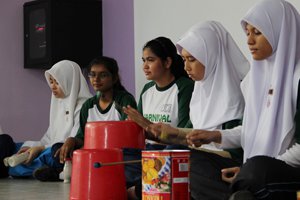
The president of Kolej Datu Patinggi Abang Haji Abdillah's environment club, which was otherwise known as PALS, then presented her slideshow presentation and talk on their school's environment club, allowing all of us to catch a glimpse of the numerous environmental initiatives that are being undertaken by other schools in our country. As the talks came to an end, so did the opening ceremony, which marked the beginning of the next item on our agenda- the tours.
The students of Kolej Datu Patinggi Abang Haji Abdillah were then divided into four groups, with each group being led by two of our members, who played the role of their 'tour guides' for the day. Meanwhile, the teachers were shown around the school by a few of our school administrators. The main feature of the tour was without a shadow of doubt, the numerous environmental initiatives we have undertaken. They managed to learn more about our green projects through the detailed, in-depth explanation their 'tour guides' provided, as well as through the exhibition booths that were set up by our club members. We were particularly pleased by the numerous suggestions their teachers made to us, which were helpful in many ways.
An short ice-breaking session was conducted before they were treated to lunch, during which we bonded with our guests through a series of entertaining conversations. We then exchanged contacts with them, before bidding a reluctant farewell, hoping to see them again.
Saturday, April 30, 2011
Tuesday, April 26, 2011
A visit from Korea
The 26th of April was certainly an eventful day for our school. After all, how often do Korean school principals pay a visit to our school? With the presence of such esteemed guests at our school, there was little wonder as to why every teacher and student went all out to show these guests a great time at our school, to the extent where Monday morning found us all learning basic Korean greetings from Puan Ngau during the weekly assembly. In case anyone is curious,the aforementioned greetings included 'annyeong haseyo', which meant 'hello', and 'kamsahamnida', which meant 'thank you'. Armed with our superior linguistic skills, we, the Eco Rangers of Sri Aman, were more than prepared to undertake our task in handling the exhibition booths we set up to showcase all our green projects.
Our Korean guests' visit began with an opening ceremony, which included a stellar performance by our school orchestra, who successfully put on a good show, as per usual. They were then taken on a tour around our school by our school administrators, during which they managed to catch a glimpse of the way our classes and lessons are conducted. They also got to see for themselves all of the green projects our school has undertaken, which included the solar panel project, rainwater harvesting project, bio-enzyme project, composting project, as well as our numerous gardening initiatives.
Booths were set up to detail the way we carry out our green projects. Our Korean guests were shown the way our Sri Aman Composter worked, which intrigued them to no end. They were also introduced to the numerous herbs available at our herbs garden, and were treated to drinks made out of our herbs. One would expect these drinks to taste awful, akin to the taste of traditional Chinese medicine, as they are, after all, herbs, but that was far from the case. Our drinks don't taste half-bad, even if we do say so ourselves. Last but not least, we introduced our Bio-Enzyme project to them, and even allowed them to get a whiff of our pleasantly-scented Bio-Enzyme.
We exchanged farewells with our guests soon after, marking the end of yet another wonderful, eventful day for us.
Friday, April 22, 2011
Planting session on the 21st of April
On the 21st April 2011, we conducted our third vegetable garden planting session. As per usual, we enlisted the help of the extremely knowledgeable and experienced Miss Tan in conducting the session. We began the session by checking on the progress of our compost, which was fermenting very well. We were pleased as the composting frame was finally ready to be removed, a sizable milestone, in our eyes. The compost was then covered by a large plastic sheet to prevent it from being damaged by the forces of nature.
We then moved on to upgrading the vegetable beds. We plowed the soil of the vegetable bed to maximise aeration and ensure that it was fully fertile. The beds of soil were then raised by around 6 inches in ease the planting process, which will be carried out in the near future. Some compost was then added to the beds to enrich the soil with nutrients, before coconut leaves were added to prevent the beds from being exposed to direct sunlight and rain.
The satisfaction of being able to complete our agendas of the day was priceless as all our tasks seemed daunting and impossible, at first. Indeed, it was a day filled with much productivity.
We then moved on to upgrading the vegetable beds. We plowed the soil of the vegetable bed to maximise aeration and ensure that it was fully fertile. The beds of soil were then raised by around 6 inches in ease the planting process, which will be carried out in the near future. Some compost was then added to the beds to enrich the soil with nutrients, before coconut leaves were added to prevent the beds from being exposed to direct sunlight and rain.
The satisfaction of being able to complete our agendas of the day was priceless as all our tasks seemed daunting and impossible, at first. Indeed, it was a day filled with much productivity.
Wednesday, April 20, 2011
Composting and Vegetable Planting on the 18th of April
It was, for all intents and purposes, a beautiful day graced by the presence of the ever-lovely sun, which had been absent for quite some time due to the storm clouds adorning our grey skies which have sadly, become part and parcel of life in our humid, tropical, piece of heaven. Though it was a Monday, a day so terrible in that it brings an end to our brief reprieve from the rigmarole of our weekday routines, that fact was overshadowed (out shined, rather, since we're talking about the sun) by the simple fact that there was no torrential downpour, no sudden thunderstorms, stopping us from achieving the motto of our day- to finish making a three-feet tall batch of compost, as well as clear all the grass from the area where we have decided to establish our vegetable garden.
Miss Tan arrived at our school bearing sacks containing materials such as wheat bran, on top of dried chicken and goat manure, which are some of the materials we would utilise in making our compost. Miss Tan has kindly sourced these materials which are more difficult to attain for us, while we worked hard at collecting all the materials we can. She also brought her trusty parang along, on top of two pitch forks, which we would require later on to mix the compost.
Our members were already hard at work by the time she arrived. Under the blazing hot afternoon sun, our members hoed at the ground, trying their very best to get rid of the grass growing on the surface of the plot of land we intended to use as our vegetable garden without removing too much of the soil, though the soil was clinging desperately onto the roots of the grass. As more of an onlooker than anything else, due to my clumsiness in performing this delicate task, I have to admit that they did a brilliant job.
Those incapable of performing the patience-stretching task of removing every inch of grass from a plot of land (such as myself), were assigned a chore that required less patience-composting. This composting session completely warped my perception towards composting, a task I previously associated with normal, clean things, such as fresh kitchen waste, soil, and maybe an adorable earthworm or two. I would never have associated composting with dried leaves, fresh grass (from the group of patient people hoeing away at the ground), rotten tofu, animal innards, manure, rice bran (the kind that's used to feed animals, not the expensive, beautifully packaged ones you see in the store), sugarcane residue, and practically everything that decomposes easily.
We had previously created a square frame for our compost, which measured around one and a half feet on each side. Using the frame a guide, we began inserting what would become the first few layers of our compost into the frame. Under the precise, detailed instructions of Miss Tan, we applied the layers in a specific order, so as to maximise the fermentation and mixing of every layer. The rough idea was that every wet layer of organic waste must be sandwiched in between a layer or two of dry layers, before yet another wet layer is applied. This is so that as the compost undergoes fermentation, the layers would naturally mix themselves up. As different types of organic waste contain different types of functions and nutrients, this would create a batch of compost that's rich is all sorts of nutrients.
In the meantime, the group of members who were assigned the task of removing all the grass from our future vegetable garden put up stakes around the plot of land, and joined every stake with long pieces of rafia strings, creating a barrier of sorts to prevent people from inadvertently stepping on our overturned soil, or newly-planted seeds, rendering all our hard labour fruitless. As for the composting group, we concluded our composting session after sandwiching the final layer of wet organic waste between dry layers. A canvas sheet was used to cover our compost and protect it from the rain. The meeting was dismissed after we cleaned our surroundings up and washed all the tools we used. After three hours of hard labour, our vision for the vegetable garden had finally begun to take shape.
It was a productive day, indeed.
Miss Tan arrived at our school bearing sacks containing materials such as wheat bran, on top of dried chicken and goat manure, which are some of the materials we would utilise in making our compost. Miss Tan has kindly sourced these materials which are more difficult to attain for us, while we worked hard at collecting all the materials we can. She also brought her trusty parang along, on top of two pitch forks, which we would require later on to mix the compost.
Our members were already hard at work by the time she arrived. Under the blazing hot afternoon sun, our members hoed at the ground, trying their very best to get rid of the grass growing on the surface of the plot of land we intended to use as our vegetable garden without removing too much of the soil, though the soil was clinging desperately onto the roots of the grass. As more of an onlooker than anything else, due to my clumsiness in performing this delicate task, I have to admit that they did a brilliant job.
Those incapable of performing the patience-stretching task of removing every inch of grass from a plot of land (such as myself), were assigned a chore that required less patience-composting. This composting session completely warped my perception towards composting, a task I previously associated with normal, clean things, such as fresh kitchen waste, soil, and maybe an adorable earthworm or two. I would never have associated composting with dried leaves, fresh grass (from the group of patient people hoeing away at the ground), rotten tofu, animal innards, manure, rice bran (the kind that's used to feed animals, not the expensive, beautifully packaged ones you see in the store), sugarcane residue, and practically everything that decomposes easily.
We had previously created a square frame for our compost, which measured around one and a half feet on each side. Using the frame a guide, we began inserting what would become the first few layers of our compost into the frame. Under the precise, detailed instructions of Miss Tan, we applied the layers in a specific order, so as to maximise the fermentation and mixing of every layer. The rough idea was that every wet layer of organic waste must be sandwiched in between a layer or two of dry layers, before yet another wet layer is applied. This is so that as the compost undergoes fermentation, the layers would naturally mix themselves up. As different types of organic waste contain different types of functions and nutrients, this would create a batch of compost that's rich is all sorts of nutrients.
In the meantime, the group of members who were assigned the task of removing all the grass from our future vegetable garden put up stakes around the plot of land, and joined every stake with long pieces of rafia strings, creating a barrier of sorts to prevent people from inadvertently stepping on our overturned soil, or newly-planted seeds, rendering all our hard labour fruitless. As for the composting group, we concluded our composting session after sandwiching the final layer of wet organic waste between dry layers. A canvas sheet was used to cover our compost and protect it from the rain. The meeting was dismissed after we cleaned our surroundings up and washed all the tools we used. After three hours of hard labour, our vision for the vegetable garden had finally begun to take shape.
It was a productive day, indeed.
![]() |
| The composting frame, surrounded by bags of waste :) |
Tuesday, April 19, 2011
Performance at SJK(C) Bukit Beruntung
On the 16th of April, our school's extremely fortunate Eco Music Band once again received an invitation for them to perform in SJK (C) Bukit Beruntung, in conjunction with their Eco Carnival, which was already in full swing by the time they arrived at the school, around seven-thirty in the morning. Upon their arrival, the band members immediately did what they could to assist the students of the school in setting up their exhibition booths at the canteen. The band members then registered themselves at the registration booth, and were each given a t-shirt.
The event began with an opening speech by the school's principal, which was followed by a video presentation, during which the band members rehearsed backstage to ensure that they would be able to perform without a hitch. Thankfully, they did manage to achieve just that, and earned the massive support of their audience.
After their performance, the VIPs who attended the carnival were taken on a tour around the exhibition area. They were very much impressed by the arts and crafts booth in particular, due to the fact that it was entirely made out of reused materials. Our band members, along with the rest of the visitors who attended the carnival, then took their time in visiting every booth available, which were not only informative, but interesting, to boot. Every band member agreed without a doubt that they had managed to learn something from the exhibition, which was great.
To end the day on a high note, our band members were then treated to gastronomic refreshments, before they finally bid a pleasant farewell to the organisers of the event and headed home, each of them pleased with the fact that even primary schoolchildren were doing their part in spreading awareness on the critical importance of saving the environment from further destruction.
The event began with an opening speech by the school's principal, which was followed by a video presentation, during which the band members rehearsed backstage to ensure that they would be able to perform without a hitch. Thankfully, they did manage to achieve just that, and earned the massive support of their audience.
After their performance, the VIPs who attended the carnival were taken on a tour around the exhibition area. They were very much impressed by the arts and crafts booth in particular, due to the fact that it was entirely made out of reused materials. Our band members, along with the rest of the visitors who attended the carnival, then took their time in visiting every booth available, which were not only informative, but interesting, to boot. Every band member agreed without a doubt that they had managed to learn something from the exhibition, which was great.
To end the day on a high note, our band members were then treated to gastronomic refreshments, before they finally bid a pleasant farewell to the organisers of the event and headed home, each of them pleased with the fact that even primary schoolchildren were doing their part in spreading awareness on the critical importance of saving the environment from further destruction.
Subscribe to:
Posts (Atom)


