Wednesday, June 16, 2010

Fruit Orchard Research

Buah Mentega
clip_image002
Local Name : Buah Mentega
Scientific Name : Diospyros blancoi
Other Names : Butter fruit, Buah margarine, Bisbul, Mabolo,
Sembolo (Java), Velvet apple, Mabolo, Buah
lemak, Marit.
Family : Ebenaceae
Explanation :
Fruit butter is the fruit which is difficult to be found. It is a tree that has two sexes; this means that there are male and female trees. It can grow up to approximately 30 meters high with a diameter of about 50 to 80 cm. They reproduce through seeds and the seed usually takes about 24 days to grow with enough water.
Usage:
The fragrant fruit is delicious when eaten alone. It can also be sliced and mixed with other fruits and made rojak buah. Fruit butter is a sweet spread made of fruit cooked to a paste, then lightly sweetened. It falls into the same category as jelly and jam. Apple butter is a common example. The fruit is cooked at first, but not too much, as the fruit will burn and soon lose its sugary taste. However, if done right, the newly made fruit butter, true to its name, has the same texture as, but different flavour than regular butter.

Ceri Terengganu
clip_image004
Local Name : Ceri Terengganu
Scientific Name : Lepisanthes alata
Other Names : -
Family :
Explanation :
The tree is non-seasonal and produces fruit throughout the year. The fruits are arranged closely and attractively in a big bunch of cluster of which each bunch consists of about 20 fruits. The fruits, about 2cm- 3cm in width are dark red, shiny and round with pointed tip. Each fruit contains 1-3 pieces of seeds and its flesh is soft and tastes fairly sweet.
Usage:
The tree is small but can reach medium height. Its canopy spreads out and purplish colour of the young leaves adds to the attractiveness of the tree. Due to this, Ceri Terengganu is usually planted for landscaping purposes.

Assam Jawa

clip_image006

Local Name : Assam Jawa
Scientific Name : Tamarindus indica
Other Names : Tamarind, Tentuli, Tentul, Sambalog, Loan-tz,
Tamarindo, Ma-kham.
Family : Fabaceae
Explanation :
It is a long-lived, medium-growth bushy tree which attains a maximum crown height of 12.1 to 18.3 metres (40 to 60 feet). The leaves are evergreen and bright green in colour. At night, the leaflets close up. The tree grows well in full sun in clay, loam, sandy and acidic soil types, with a high drought and aerosol salt (wind-borne salt as found in coastal area) resistance.
Usage:
The tamarind is best described as sweet and sour in taste, and high in acid, sugar, vitamin B and interestingly for a fruit, calcium. The fruit pulp is edible. It is often used as a component of savory dishes. The leaves are used as an herbal infusion for malarial fever, the fruit juice as an anti-septic and even cough cure. Tamarind heartwood can be used in making furniture and wood flooring and has recently become popular in bonsai culture. In temples, especially in Buddhist Asian countries, the fruit pulp is used to polish brass shrine furniture, removing dulling and the greenish patina that forms.
Tampoi

clip_image008

Local Name : Tampoi
Scientific Name : Baccaurea macrocarpa
Other Names : Baccaurea griffithii
Family : Phyllanthaceae
Explanation :
Baccaurea macrocarpa, also called Tampoi, is a small, tropical rainforest sub storey fruit trees native to Southeast Asia, especially Borneo. It is dioecious, and the female trees bear fruit directly on the trunk and large branches. The fruit is large, orange-skinned, white-fleshed, with a delicious tangy flavour somewhat like mandarin (tangerine). Depending on conditions, the fruit may closely clothe the trunk beautifully, like the fruit of many Ficus species.
Usage:
The fruit is edible and delicious sweet taste. Kayunya kuat dan tahan lama oleh karena itu dapat dimanfaatkan sebagai bahan bangunan.The wood is strong and durable and therefore, it can be used as building material.


Belimbing Buluh

clip_image010
Local Name : Belimbing Buluh
Scientific Name : Averrhoa bilimbi
Other Names : Balimbing, Bilimbi, Blim-blim, Bimbli,
Belimbing, Blimbling, Biling, Bimbiri, Cucumber
tree, Tree sorrel, Soure.
Family : Phyllanthaceae
Explanation :
The bilimbi tree reaches a height of 16 to 35 ft. It has a short trunk dividing into upright branches. The dark-red flowers, appearing in panicles, from the trunk and oldest branches, are small and fragrant. The bright-green fruit, 2-3½" in length, emerge directly from the trunk, often in clusters. The brown seeds are flattened and very small. The origin of this plant is Indonesia and since this plant is a tropical species it is sensitive to the cold, especially young plants. This fruit is too acid for eating raw but the green uncooked fruits are prepared as a relish in Suriname. They are also used to prepare chutney (a sweet and sour condiment).
Usage:
In Malaysia the leaves of bilimbi are used as a treatment for venereal disease. A leaf decoction is taken as a medicine to relieve rectal inflammation. It seems to be effective against coughs and thrush.
Nam-Nam

clip_image012

Local Name : Nam-nam
Scientific Name : Cynometra cauliflora
Other Names : -
Family : Fabaceae
Explanation :
Cynometra cauliflora or commonly Nam-nam is a native of Malaysia, grown mainly in northern Peninsular Malaysia and can be more widely cultivated in other states, mainly in kampungs and villages. This tree belongs to the bean family. It is a small tree with a thick much branched stem. The flowers are rather small about 1.2 cm across. They appear on the stem in clusters.
Usage :
The mature fruit can be eaten fresh or cooked with sugar to make sweets (compote). It can also be made into a fruit salad, pickled, or be used to prepare a special 'sambal.' The tree makes an attractive ornamental plant in home gardens and is also potted and grown as bonsai plant.
clip_image014Cermai Belanda

Local Name : Cermai Belanda
Scientific Name : Eugenia Uniflora L.
Other Names : -
Family : Myrtaceae
Explanation :
It is widely planted in the tropical rainforests in America. It will start flowering and producing fruits after 2 years.
Usage :
The seed of this plant has toxic chemicals that can shrink tissues and proteins of the skin. It is also rich in Vitamin C. The leaf can be boiled and drank as a cure for high fever.

Kedondong
clip_image016
Local Name : Kedondong
Scientific Name : Spondias Cytherea Sonnerat
Other Names : Umbra, Spondias dulcis, ambarella,
Pomarosa
Family : Anacardiaceae
Explanation :
This fast growing tree can reach up to 60 ft (18 m) in its native homeland of Melanesia through Polynesia; however, it usually averages out at 30 to 40 ft (9-12 m) in other areas. Spondias dulcis has deciduous, “pinnate leaves, 8 to 24 in (20-60 cm) in length, composed of 9 to 25 glossy, elliptic or obovate-oblong leaflets 2 1.2 to 4 in (6.25-10 cm) long, finely toothed toward the apex” (Morton 1987).
Usage :
The kedondong fruit has Vitamin C that is important for blood hemoglobin and sitokrom molecular. It can also reduce cholesterol and blood pressure.
Rhedia
clip_image018
Local Name : Achacharu Plant
Scientific Name : Rhedia SP
Other Names : -
Family : Rhediae
Explanation :
This plant grows about 6 to 9 feet only. It starts fruiting after three to four years. These trees will thrive under a humid, wind-free environment if provided with a low pH soil and ample moisture.
Usage:
In its native land the achacharu remains as a home garden fruit and is consumed fresh out-of-hand or made into delicate and refreshing juices. In tropical America the achacharu has considerable potential as a cross purpose ornamental, home garden and commercial fruit crop. Due to its small stature it is perfect for small spaces or even permanent use in a container.
Jambu Bol
clip_image020
Local Name : Jambu Bol
Scientific Name : Syzygium Malaccense
Other Names : Malacca Apple, Malay Rose Apple,
Pommerac
Family : Myrtaceae
Explanation :
Syzygium Malaccense, commonly known as Malacca Apple, is a species of flowering tree that is native to Malaysia and Indonesia. It is also known as Jambu Bol, Malay Rose Apple, Otaheite Cashew and Pommerac. The fruit is Oblong-shaped and dark red in color, although some varieties have white or pink skin. The flesh is white and surrounds a large seed. They flower in early summer, bearing fruit three months afterward. In Costa Rica they flower earlier, with ripe fruit in June.
Usage:
Highly ambiguous terms, such as rose apple, water apple, mountain apple, pomarrosa or plum rose are sometimes used for this plant or its fruit; they can refer to almost any species of Syzygium grown for its fruit. Jam is prepared by stewing the flesh with brown sugar and ginger.

Kundang
clip_image022
Local Name : Kundang
Scientific Name : Bouea macrophylla
Other Names : Marian Plum, Gandaria, Plum Mango
Family : Anacardiaceae
Explanation :
The evergreen tree grows to height of 25 meters. The fruit (resembling a mango) are green in color and mature to an orange or yellow. They grow to roughly 2 to 5 cm in diameter. The entire fruit, including its single seed, is edible. The fruit range from sweet to sour in flavor, and have a light smell of turpentine.
Usage :
Both the leaves and fruit from the tree can be eaten. The leaves can be eaten raw when they are still young, and can be used in salads. While the seed is edible, the endosperm is generally bitter. Fruit can be eaten raw, or made into dishes such as pickle, compote, or sambal. Unripened fruit can be used to make rojak and asinan.

Binjai
clip_image024
Local Name : Binjai
Scientific Name : Mangifera Caesia
Other Names : Malaysian Mango
Family : Anacardiaceae
Explanation :
Mangifera Caesia is a species of flowering plant in the cashew family, Anacardiaceae. Common names include Malaysian Mango, Binjai , Wani, yaa-lam (Thai language), and Bayuno. It belongs to the same genus as the mango and is widely cultivated in areas of Malaysia, Indonesia, Singapore, Brunei, Papua New Guinea, and the Philippines. The tree lives in lowlands or gentle slopes in sandy clay soils.
Usage :
The Binjai is believed to originate from the island of Borneo, but is commonly grown elsewhere for its edible fruit. The fruit can be eaten dipped in chili and dark soy sauce. The wood is used for light construction. Binjai is almost always propagated by seed.
clip_image026Banana

Local Name : Banana
Scientific Name : Musa SP
Other Names : -
Family : Musaceae
Explanation :
Banana is the common name for herbaceous plants of the genus Musa and for the fruit they produce. Bananas come in a variety of sizes and colors when ripe, including yellow, purple, and red. In popular culture and commerce, "banana" usually refers to soft, sweet "dessert" bananas. Bananas from a group of cultivars with firmer, starchier fruit are called plantains.
Usage :
The banana is widely used in cooking. It can be deep fried, baked in their skin in a split bamboo, or steamed in glutinous rice wrapped in banana leaf. The tender core of the banana plant’s trunk is also used in a Burmese dish which is Mohinga.
clip_image028Jambu Air

Local Name : Jambu Air
Scientific Name : Syzygium SP
Other Names : Wax Apple , Chambekka, Jamrul
Family : Myrtaceae
Explanation :
It is a tropical tree growing to 12 m tall, with evergreen leaves 10-25 cm long and 5-10 cm broad. The flowers are white, 2.5 cm diameter, with four petals and numerous stamens. The fruit is a bell-shaped edible berry, with colors ranging from white, pale green, green, red, purple, crimson, to deep purple or even black, 4-6 cm long in wild plants. When mature, the tree is considered a heavy bearer and can yield a crop of up to 700 fruits
Usage :
The sweetest fruits, which are the red ones, are eaten after the core is removed. The fruit is usually served uncut, in order to preserve the unique bell shape presentation.
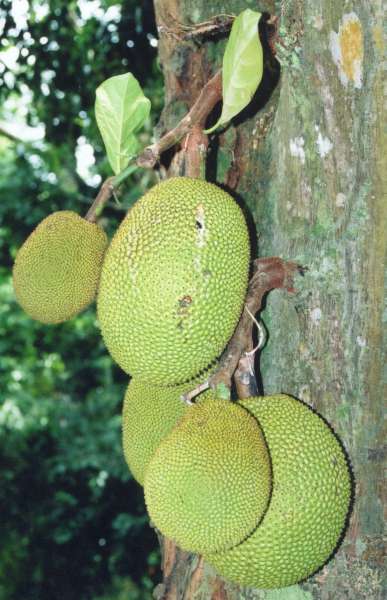
Jackfruit
clip_image030

Local Name : Jackfruit
Scientific Name : Artocarpus Heteropyllus
Other Names : -
Family : Moraceae
Explanation :
It is a plant which grows well in lowlands. It’s fruit is the largest tree borne fruit in the world, seldom less than about 25 cm in diameter. The jackfruit has played a significant role in Indian agriculture for centuries. Archeological findings in India have revealed that jackfruit was cultivated in India 3000 to 6000 years ago.
Usage :
This fruit can be found in Asian countries especially Phillipines. The flesh of the jackfruit is starchy and fibrous. It provides food energy and dietary fibre. In many cultures, the young jackfruit is boiled and used in curries as a staple food.
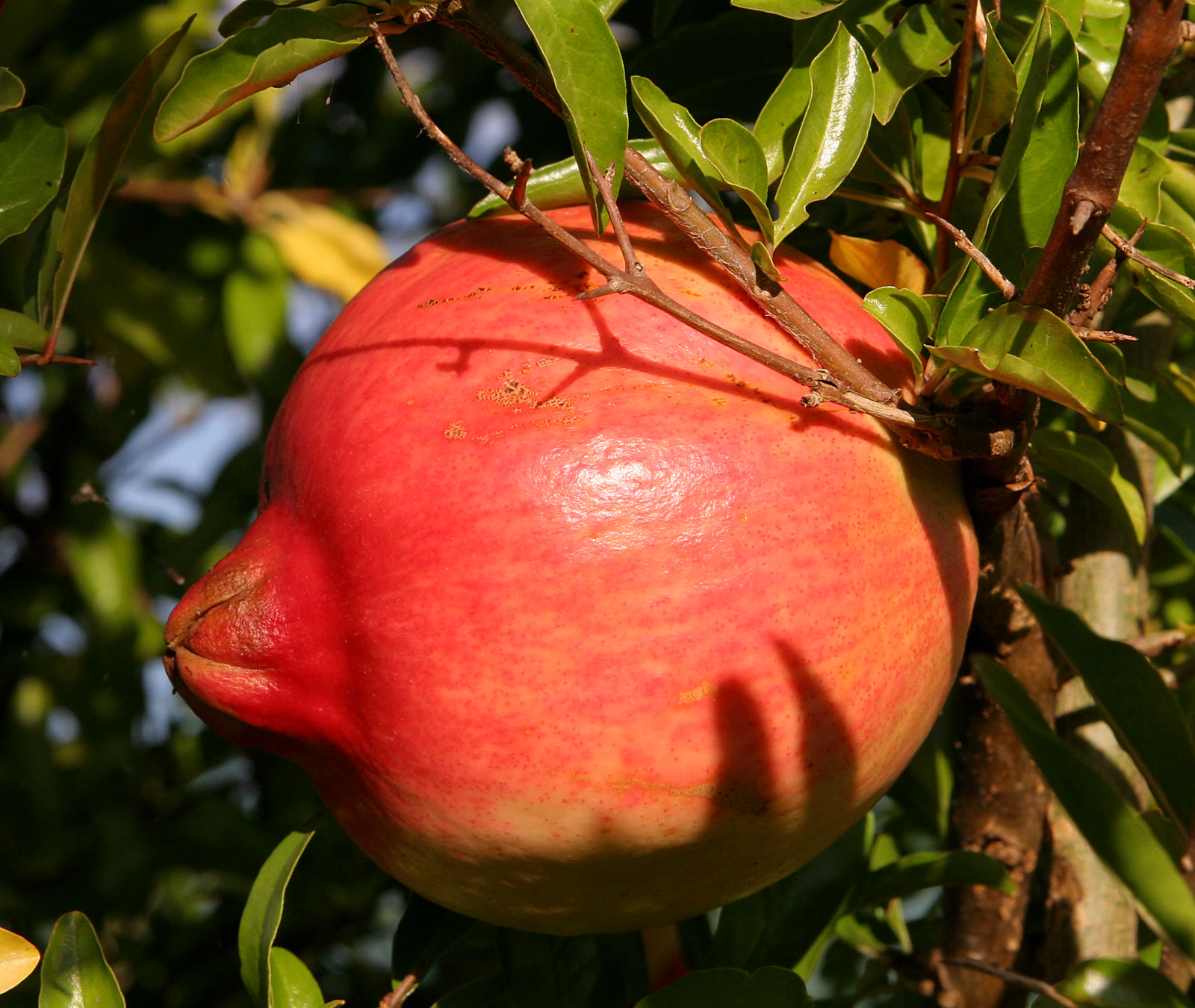
Pomegrana te
clip_image032

Local Name : Pomegranate
Scientific Name : Punica Granatum
Other Names : Punica Malus
Family : Lythraceae
Explanation :
A pomegranate is a fruit-bearing shrub growing to between five and eight meters tall. It is widely cultivated throughout Armenia, the drier parts of southeast Asia, peninsular Malaysia, and tropical Africa. In the Northern Hemisphere, the fruit is typically in season from September to February. In the Southern Hemisphere, it is in season from March to May.
Usage :
This fruit can be eaten after it’s shell has been open. After opening the pomegranate, the arils are separated from the peel and internal white pulp membranes. The pomegranate juice is popular in Persia and India.
clip_image034Jambu Mawar

Local Name : Jambu Mawar
Scientific Name : Syzygium Jambos
Other Names : Eugenia Jambos, Rose Apple
Family : Myrtaceae
Explanation :
This plant is native to Southeast Asia but is neutralized in India, especially Kerala. It can be quite invasive in areas where it has been introduced. It is a threat to several ecosystems, including those on several Hawaiian islands.
Usage :
It is usually eaten fresh or used in preserves. Rose apples spoil very quickly so fruits should be used soon after picking. The large, hollow seed cavity is sometimes utilized to stuff the fruits and bake them. Fruit extract can be used to make a sweet smelling rose water.

Orchid Walkway Research

Anota Violacea Orchid
clip_image002
Common Name : Rhynchostylis retusa
Family : Orchidaceae
Other Names : Rhynchostylis Violacea, Epidendrum retusum, Aerides guttata, Aerides praemorsa, Aerides retusa, Aerides spicata, Aerides undulate, Epidendrumhippium, Epidendrum indicum, Gastrochilus blumei, Gastrochilus garwalicus.
Explanation :
These monopodial orchids originally came from the Philippines. These orchids have a full spray of many miniature lavender and white flowers. This plant blooms in the winter and in the spring. The orchid prefers intermediate to warm temperatures, filtered light, and even moisture.
Anguloa Uniflora Orchid
clip_image004

Common Name : Anguloa Uniflora Orchid
Family : Orchidaceae
Other Names : Anguloa uniflora var. treyeranii
Explanation :
Anguloa uniflora (boat orchid, tulip orchid) was named in honor of Don Francisco de Angulo, Director-General of Mines, in Peru, at the end of the 18th century. The tulip orchid usually blooms in the spring and in the summer. It prefers intermediate to cold temperatures and shade. It should be kept evenly moist. It needs less water in winter. To encourage flowering, watering should be decreased after it has finished its growth.


Ascocentrum Curvifolium Orchid
clip_image006
Common Name : Ascocentrum curvifolium
Family : Orchidaceae
Other Names : Saccolabium curvifolium, Saccolabium miniatum, Gastrochilus curvifolius, Ascocentrum curvifolium f. luteum.
Explanation :
A six inch monopodial plant from Thailand, Ascocentrum curvifolium has a full spray of half-inch, orange-red flowers. The offspring have the small plant size of the ascocentrum combined with the larger flower size of the vanda. It blooms in late spring and in the summer. It prefers intermediate to warm temperatures, filtered light, and even moisture.

Brassavola Orchid
clip_image008

Common Name : Brassavola
Family : Orchidaceae
Other Names : Eudisanthema, Lysimnia, Tulexis
Explanation :
Brassavola is a genus of 20 orchids. The name comes from the Venetian nobleman and physician Antonio Musa Brassavola. These species are native to the lowlands of Central America and tropical South America. They are epiphytes, and a few are lithophytes. A single, apical and succulent leaf grows on an elongated pseudobulb. The orchid yields a single white or greenish white flower, or a raceme of a few flowers. The three sepals and two lateral petals are greenish, narrow and long. The base of the broad fringed lip enfolds partially the column. This column has a pair of falciform ears on each side of the front and contains twelve (sometimes eight) pollinia.
Bulbophyllum Lobbii Orchid
clip_image010
Common Name : Bulbophyllum Lobbii
Family : Orchidaceae
Other Names : Sarcopodium lobbii, Sestochilos uniflorum, Bulbophyllum siamense, Phyllorkis lobbii, Bulbophyllum claptonense, Bulbophyllum polystictum, Bulbophyllum sumatranum.
Explanation :
Bulbophyllum lobbii has two inch, egg-shaped pseudobulbs with a single leaf. The plant is usually under twelve inches tall. The fragrant, single, four inch flower is buff with a yellowish lip. This plant blooms in late spring and summer. Bulbophyllum lobbii prefers cool to cold temperatures, filtered light, and to be kept evenly moist.
Cattleya Orchid
clip_image012
Common Name : Cattleya
Family : Orchidaceae
Other Names : -
Explanation :
Cattleya is a genus of 42 species of orchids from Costa Rica to tropical South America. The genus was named in 1824 by John Lindley after Sir William Cattley, who received and successfully cultivated specimens of Cattleya labiata that were used as packing material in a shipment of other orchids. They are widely known for their large, showy flowers, and were used extensively in hybridization for the cut-flower trade until quite recently. The flowers of the hybrids can vary in size from 5 cm to 15 cm or more. They occur in all colors except true blue and black.
Chysis Laevis Orchid
clip_image014
Common Name : Chysis Laevis
Family : Orchidaceae
Other Names : -
Explanation :
A deciduous orchid, the pseudobulbs of the Chysis laevis are often bare most of the year. The waxy, yellow flowers are touched with violet. The flower stem, which grows from the base of the plant, sometimes grows down rather than up.
Chysis laevis blooms in the spring and in the summer. The flowers last two to three weeks. It prefers intermediate temperatures, filtered light, and to be kept evenly moist during active growth.

Cycnoches Loddigesii Orchid
clip_image016
Common Name : Loddiges' Cycnoches
Family : Orchidaceae
Other Names : Cycnoches Cucullata Lindley,
Cycnoches Loddigesii Var Leuchochilum
Explanation :
This plant is found growing in French Guiana, Venezuela, Colombia and a few more places. Grow in intermediate to warm conditions. We must water it regularly during growing season. Plants can die easily from over watering. Female flowers will often be produced when high light and low moisture is present.
Cymbidium Orchid
clip_image018
Common Name : Boat Orchids
Family : Orchidaceae
Other Names : Cyperochis Blume, Iridorchis Blume, Jensoa, Pachyrhizanthe Nakai
Explanation :
Cymbidium plants can grow up to a height of 60 cm. Each flower can have a diameter of 5 - 10 cm. They bloom during the winter, and each plant can have up to fifteen or more flowers. The fantastic range of colours for this genus include white, green, yellowish-green, cream, yellow, brown, pink, and red but not blue and black. The flowers last about ten weeks.
clip_image019Dendrobium Orchid
Common Name : Pink Rock Orchid
Family : Orchidaceae
Other Names : Callista Lour. Ceratobium, Pierardia, Thelychiton
Explanation :
Dendrobium species have adapted to a wide variety of habitats, from the high altitudes in the Himalayan Mountains to lowland tropical forests and even to the dry climate of the Australian desert. These orchids grow quickly throughout summer, but take a rest during winter. Reproduction is usually through seed, but a few species reproduce asexually through keikis; produced along the stem, usually after flowering and sometimes as a result of injury to the growing tip.
Doritis Orchid
clip_image021
Common Name : Phalaenopsis pulcherrima
Family : Orchidaceae
Other Names : Phalaenopsis pulcherrima, Grafia A. D. Hawkes, Kingidium P. F. Hunt , Kingiella Rolfe
Explanation :
Doritis pulcherrima is a plant from east Asia. It is the only species in its genus. Doritaenopsis hybrids are derived from crossing Doritis with Phalaenopsis. Doritis pulcherrima is a highly variable phalaenopsis-like plant. The leathery leaves grow about eight inches long. Long lasting flowers bloom on a tall spike. Give Doritis intermediate to warm temperatures, filtered light, and even moisture.
Epidendrum Orchid
clip_image023
Common Name : Epidendrum
Family : Orchidaceae
Other Names : Amphiglottis, Anacheilium, Anocheile, Auliza, Coilostylis
Explanation :
Epidendrum are found from the Carolinas to Argentina. The flowers range in size from a quarter of an inch to six inches. Many of the flowers are fragrant. Epidendrum aromaticum has very fragrant flowers which appear from summer to fall. It prefers intermediate temperatures. Epidendrum cochleatum flowers from summer to fall.

Laelia Orchid
clip_image025
Common Name : Laelia
Family : Orchidaceae
Other Names : Amalia
Explanation :
Laelias are closely related to Cattleya. Laelia orchids vary tremendously in size. Some have flower sprays eight to ten feet long. The bright yellow, red, bronze, deep purple, and green flowers have been very attractive to all.
Lockhartia Oerstedii Orchid
clip_image026
Common Name : Braided Orchid
Family : Orchidaceae
Other Names : Phalaenopsis pulcherrima, Grafia A. D. Hawkes, Kingidium P. F. Hunt , Kingiella Rolfe, Polychilos Breda
Explanation :
Lockhartia oerstedii which is found growing from Mexico to Panama, belongs to a genus that was named in honor of David Lockhart. Lockhartia oerstedii grows one to two feet tall and has one-half to one inch, red spotted, yellow flowers.
Lycaste Orchid

clip_image028
Common Name : Lycaste
Family : Orchidaceae
Other Names : Deppia
Explanation :
The Lycaste were named after Lycaste, a beautiful daughter of Priam, the King of Troy. They grow in Central and South America and the West Indies. The white form of Lycaste virginalis, which is often sold under the name Lycaste skinneri, is the national flower of Guatemala. Lycaste orchids can bloom more than once a year. Lycastes prefer cool to warm temperatures and shady to filtered light. More light is needed after the pseudobulbs mature.
Maxillaria Houtteana Orchid
clip_image030
Common Name : Houtte's Maxillaria
Family : Orchidaceae
Other Names : Maxillariella houtteana
Explanation :
Maxillaria houtteana belongs to a genus of over 300 very different species found from Florida to Brazil. The single, leathery, cinnamon-brown flowers usually appear in the fall, in the winter, and in the spring. Some plants are ever-blooming. Give Maxillaria houtteana orchids intermediate to warm temperatures and filtered to bright light. Drench and let dry. This plant needs good air circulation and excellent drainage.
Miltonia Orchid

clip_image032
Common Name : Miltonia
Family : Orchidaceae
Other Names : Anneliesia, Macrochilus
Explanation :
The genus Miltonia was named after Viscount Milton, an English patron of horticulture. The species is divided into the warmer growing, small-flowered varieties from Brazil, and the cooler growing, large-flowered varieties from the Colombian Andes. The greatest difficulty in growing Miltonias is keeping them cool enough in the summer so they do not exhaust themselves. These orchids are attractive even out of bloom.
Odontoglossum Orchid

clip_image033clip_image035
Common Name : Odontoglossum
Family : Orchidaceae
Other Names : Tiger Orchid
Explanation :
The genus Odontoglossum contains about 300 diverse species of orchids that grow from Mexico to Bolivia. The flowers vary greatly in size and are long-lasting. The flowers bloom between fall and spring. Odontoglossum generally do best when the roots are tightly confined. They need high humidity, excellent drainage, and even moisture.
Oncidium Orchid

clip_image037
Common Name : Oncidium
Family : Orchidaceae
Other Names : Cohnia, Xaritonia, Lophiaris
Explanation :
Oncidium is a large genus of over 700 species of orchids found growing from southern Florida to Argentina. Oncidium orchids adjust well to indoor living. Generally, they prefer cool to intermediate temperatures, full sun, and plenty of water while they are actively growing. There are many small Oncidiums that like it warm and grow easily under lights. Some have flower sprays four to six feet long. It may be necessary to move the plant foliage out of the way so the flower sprays can get light when the plant begins to bloom.
Paphiopedilum Orchid
clip_image039
Common Name : Paphiopedilum
Family : Orchidaceae
Other Names : Cordula, Menephora, Stimegas
Explanation :
Paphiopedilum orchids are mostly terrestrial, dwarf to moderate sized plants that have flat leaves growing from a fanlike base. After the new leaves form, the flower stem rises up from between the leaves. The long lasting, two to five inch flowers usually grow on individual stems six to twenty inches tall.
Phalaenopsis Orchid
clip_image041
Common Name: Phalaenopsis
Family: Orchidaceae
Other Name: Moth Orchids
Explanation:
They are native throughout southeast Asia from the Himalayan mountains to the islands of Polillo Palawan and Zamboanga del Norte in the island of Mindanao in the Philippines and northern Australia. Orchid Island of Taiwan is named after this genus. In the wild, some species grow below the canopies of moist and humid lowland forests, protected against direct sunlight; others grow in seasonally dry or cool environments. The species have adapted individually to these three habitats.
They bloom in their full glory for several weeks. If kept in the home, the flowers may last two to three months. Some Phalaenopsis species in Malaysia are known to use subtle weather cues to coordinate mass flowering.
Pleurothallis Orchid
clip_image043
Common Name: Pleurothallis
Family: Orchidaceae
Other Name: Bonnet Orchids
Explanation:
They grow in dry or wet, tropical or temperate climates.
As a group they show a huge range in vegetative form, and can be found as tall cane-like plants, pendent or climbing, erect or creeping, tufted and tiny, delicate moss-like species that can grow on the thinnest of twigs. They all have two pollinia; and they have reduced their pseudo bulbs and instead, some species have thick succulent leaves. Their flowers are among the most diverse and unusual, although they are often very small.
Renanthera Orchid
clip_image045
Common Name: Renanthera
Family: Orchidaceae
Other Names: Nephranthera Hassk
Explanation:
Abbreviated as Ren, it is a genus of large scrambling monopodial epiphytic and terrestrial species distributed from India, New Guinea, and through to the Philippines. They produce a branched inflorescence containing numerous flowers ranging in color from yellow and orange to red and possess large lateral sepals. They usually require an intermediate to hot climate with good air movement and generally bright light. Their scrambling style of growth means they are best grown on a hanging mount or basket. If they are grown in pots there must be excellent drainage.

Rodriguezia Secunda Orchid
clip_image047
Common Name: Rodriguezia
Family: Orchidaceae
Other Name: Byurlingtonia Lindl.
Explanation:
Rodriguezia secunda was named in honor of Don Manuel Rodriguez, the Spanish botanist and apothecary. An epiphyte with compressed pseudobulbs and narrow leaves, Rodriguezia secunda is a small to miniature plant that does especially well under artificial light. The six inch spray has 20 to 30 rosy flowers that grow on one side of the stem. Its blooming time is quite variable. Rodriguezia secunda prefers cool temperatures, bright to filtered light, perfect drainage, and to be kept evenly moist.
Sophronitella Violacea Orchid
clip_image049
Common Name: Sophronitella
Family: Orchidaceae
Other Names: -
Explanation:
It is a small plant, rarely more than 2" tall, with longitudinally keeled, fusiform and darkly pigmented pseudo bulbs. The inflorescence is protected by a small sheath on top of the pseudo bulb, and can produce more than one flower on a long succession, meaning that usually only one flower (or rarely 2) is open at a time. They produce fairly large flowers (about 1" or slightly more across) for such a small plant. The flowers themselves are quite showy and very colorful. Even with such a wide distribution range, the flowers look always about the same regardless of where the plants came from.
Stanhopea Orchid
clip_image051
Common Name: Stanhopea
Family: Orchidaceae
Other Names: Aptly upside-down orchids.
Explanation:
The abbreviation used is Stan. These epiphytic, but occasionally terrestrial orchids can be found in damp forests from Mexico to NW Argentina. Their ovate pseudo bulbs carry from the top one long, plicate, elliptic leaf. It is noted for its complex and usually fragrant flowers that are generally spectacular and short-lived. Their pendant inflorescences are noted for flowering out of the bottom of the containers in which they grow, lending themselves to culture in baskets that have enough open space for it to push through. They are sometimes called aptly upside-down orchids.
Vanda Orchid
clip_image053
Common Name: Vanda
Family: Orchidaceae
Other Names: Blue Orchid (Vanda Coerulea)
Explanation:
The genus has a monopodial growth habit with leaves that are highly variable according to habitat. Some have flat, typically broad, ovoid leaves (strap-leaves), while others have cylindrical (terete), fleshy leaves and are adapted to dry periods. Most show a yellow-brown color with brown markings, but they also appear in white, green, orange, red and burgundy shades. They bloom every few months and the flowers last for two to three weeks. This genus is one of the five most horticulturally important orchid genera, because it has some of the most magnificent flowers to be found in the entire orchid family. Many Vanda orchids are endangered, because of habitat destruction.

Mini Eco Forest Research

Cinnamon Plant
clip_image002

Family : Lauraceae
Other Names : C. Zeylanicum Blume, Cinnamomum Verum
Explanation : Cinnamon' trees are 10–15 metres tall. The leaves are oblong in shape, 7–18 cm long. The flowers are green in color. The fruit is a purple 1-cm berry containing a single seed.
Special usage : A spice, Used in the preparation of chocolate and in savory dishes of chicken and lamb.


Kasai Plant
clip_image004

Family : Sapindaceae
Other Names : Pometia Pinnata, Pomentia Pomentosa
Explanation : This kasai plant is a very beautiful plant. Its shoots are light red in colour. The stem of this plant can reach a diameter of 90 cm. It has many local names such as Sibu, Truong and Agupanga. This plant is widely planted in Malaysian rainforests.

Penaga Lilin Plant
clip_image006

Family : Guttiferae
Other Names : Iron wood tree, Mesua Naghas (French), Nagkesara (Tamil), Messua Ferrea L.
Explanation : This plant has a tree trunk which is pale brown in colour. bahagian dalam kulit batangnya mengandungi resin yang berwarna jernih.Pucuknya berwarna merah dan daunnya berwarna hijau. This plant has red and green leaves. daunnya berbentuk ringkas dengan saiz 6.5-12 X 1.5-4 cm.Bunganya berwarna putih dan berbau wangi. It’s short shaped leaves measure 6.5-12 X 1.5-4 cm. The flower is white and has a very nice fragrance.
Special usage : In Burma, it is used as a snakebite remedy. The flowers are used in to return fitness of pregnant women after giving birth. Its seeds will be pounded and the seeds are used to heal wounds and treat skin infections.
Kelat Paya Plant
clip_image007

Family : Myrtaceae
Other Names : Eugenia Papillose Duthie, Eugenia Oleina
Explanation : Its leaves are orange-red in colour. This plant is widely planted in Malaysia since Malaysia’s weather is suitable for the plants growth.
TECOMA STANS PLANT
clip_image009

Family : Bignoniaceae
Other Names : Stenolobium Stans, Yellow Bells, Yellow Trumpetbush, Yellow Elder, Ginger Thomas, Esperanza
Explanation : This is a shrub or a small tree with clusters of bright yellow, bell-shaped flowers. In its native habitat which is America, it flowers seasonally. When first introduced in Malaysia, it flowered several times a year, producing a great profusion of flowers each time, followed by masses of fruits with winged seeds. Now, most garden specimens flower throughout the year, but seldom profusely.
FICUS RELIGIOSA PLANT
clip_image011

Family : Moraceae
Other Names : Weeping fig, Benjamin’s Fig
Explanation : This widespread species has small leaves and is a favourite potted house plants in temperate countries. In Malaysia, it is commonly planted by the roadside. Wild plants often establish themselves as epiphytes on oil palms and other trees. Its roots grow down to the soil, while side roots link up with each other to form “baskets” around the host trees. Eventually, the host trees die and the fig baskets become independent pillar-trunks. Some cultivars have white-variegated leaves.
MEDANG TEJa PLANT
clip_image012

Family : Cinnamomum
Other Names : Medang Kemangi, teja badak, teja Lawang, Kayu Manis Hutan, Keningau, Mandiapa, Medang
Explanation : It is a type of plant which grows widely in Malaysia. Its botanical name is Cinnamomum Iners Reinw ex. BI. The leaves of this plant is pink when young, has three longitudinal veins, crushed fresh leaves and an inner bark with strong smell of cinnamon. It’s fruit is green with yellow spots when young and dark blue when ripen.
FICUS BENJAMINA PLANT
clip_image014

Family : Cinnamomum
Other Names : Ara, Weeping fig, Benjamin’s fig
Explanation : Ficus benjamina is often sold in stores as just a "Ficus", is a species of fig tree, native to south and southeast Asia and Australia. It is the official tree of Bangkok, Thailand. It is a topiary tree reaching 30 metres (98 ft) tall in natural conditions, with gracefully drooping branchlets and glossy leaves 6–13 cm (2–5 in) long, oval with an acuminate tip.
KEMUNING PLANT
clip_image016

Family : Rutaceae
Other Names : Orange Jasmine, murraya paniculata, Murraya Exotica
Explanation : Orange Jasmine is a small, tropical, evergreen tree growing up to 7 m tall. The plant flowers throughout the year. The fruit of Murraya paniculata is fleshy, oblong-ovoid, coloured red to orange, and grows up to 1 inch in length.
Special Usage : it is widely used in traditional medicine as an analgesic and for wood (for tool handles).
Jatropha PLANT
clip_image017

Family : Euphorbiaceae
Other Names : Fiddlehead Jatropha, Jatropha Pandurifolia
Explanation : It is a large shrub with clusters of tiny flowers. Jatropha pandurifolia has red flowers. To make sure the plant grows well, it needs a moderate volume of water and full sun. It usually flowers throughout the year.
BAMBUSA PLANT
clip_image019

Family : Poaceae
Other Names : Bamboo plant
Explanation : It is a type of plant which are usually giant ones, with numerous branches at a node and one or two much larger than the rest. They are found in tropical and subtropical areas of asia, especially in the monsoon and wet Tropics.
Special Usage : It is used in chinese medicine for treating wounds. In indonesia, the bamboo shoots are thinly sliced and then boiled with santan and spices to make a dished called gulai rebung.
JELUTONG PLANT
clip_image021

Family : Apocynaceae
Other Names : Dyera Costulata
Explanation : The jelutong is a species of tree in the oleander subfamily. It grows to about 60 metres (200 ft) tall with diameters of 2 metres (5 to 6 ft), or even to 80 m (260 ft) tall with diameters to 3 m (10 ft), and boles clear and straight for 30 m (90 ft). It grows in Malaysia, Borneo, Sumatra and southern Thailand. Its natural distribution is scattered locales in low-elevation tropical evergreen forest.
EUGENIA OLEANA PLANT
clip_image023

Family : Myrtaceae
Other Names : -
Explanation : It is a flowering plant of the Myrtaceae family. It has a worldwide, although highly uneven, distribution in tropical and subtropical regions. The bulk of the approximately 1,000 species occur in the New World tropics, especially in the northern Andes, the Caribbean, and the Atlantic Forest (coastal forests) of eastern Brazil. Other centers of diversity include New Caledonia and Madagascar. It is a woody evergreen trees and shrubs. Several are grown as ornamental plants for their attractive glossy foliage.

Saturday, June 5, 2010

Malaysian Nature Society Open Day on the 5th of June


On the 5th of June, the Malaysian Nature Society held a national open day in Taman Lembah Kiara in conjunction with World Environment Day. Five of our members, Farhanah, Siti Sarah, Niraanjana, Angela and Jo Ee, attended the open day where many activities were held and many booths were set up. Among the activities they had planned were nature walks, stream ecologies, face painting, scavenger hunt and story telling while the numerous booths were set up by many organisations and societies including PERHILITAN, Malaysian Nature Society and PETA. 

There was even one booth set up by the TTDI Warga Mas, where they had displayed many creative and beautiful handmade products, such as a quilted soft toy, a mat made of rolled up pieces of cloth which were then painstakingly pieced together, minuscule cardboard boxes made of greeting cards, and even knitted pairs of adorable mittens for infants. Each of those beautiful works of art were labelled with the names of their creators, along with their age. We were all suitably impressed by the fact that a 97 year old lady had managed to make a quilted soft toy, and even more so by the booth operators proclamations that doing so was 'easy'. I can't imagine what their reactions would be after watching my failed attempts at frying an egg.

The event kicked off with an opening ceremony where the gorgeous Amber Chia officiated the event, and after the event had been officiated, Angela and Jo Ee went for a stroll around the park as well as take a look at the booths. There were many booths displaying interesting information at the venue, one of which was MYCAT, an organization devoted to ending the poaching of tigers for their fur and bones. Two bones were displayed at the booths, as well as numerous articles on the heartlessness of poaching. 

At 10.50 am, Jo Ee and Angela made their way to where participants of the scavenger hunt were supposed to gather, and after a briefing session was given, the participants took off. The scavenger hunt required its' participants to search for a number of things, and participants can opt to either collect said items, or take photographs of them. Examples of the things participants were required to find included: Something a bird would eat, a skeleton of an animal or plant, an epiphyte, a soil-improving plant, and many others. Jo Ee and Angela were the first team who arrived back at base, and accumulated 24 points out of 26. They later emerged champions of the student category scavenger hunt, and walked away with a Nestle hamper, a Deauter backpack, and a Coleman tent. These prizes were worth a staggering RM350 in total, and Jo Ee and Angela were elated.

After the scavenger hunt, they saw a group of people climbing up a tall tree aided by a harness, and eagerly requested for a try, as well. After a long wait, it was finally their turn. The volunteers put the harnesses on them, and they were ushered off the the climbing area where they were attached to the rope which they would later have to climb. Jo Ee had no trouble making her way up the rope, but Angela took quite a while getting the hang of it, and by the time she finally understood how the harness worked, the person who was latched on to rope at the same time she was had completed his mission. Still, Angela eventually made her way up the rope, straining her arms and legs as hard as possible, and her trip down the rope was a triumphant one. 

She would realise, over the course of the next 5 days, that the after effects of rope climbing aren't pleasant in the slightest.

Though Angela and Jo Ee had signed up for a nature walk, they lost the nature walk group in their endeavor to take full advantage of the water cooler, and finally decided that tracking the group down in that maze of a park would be akin to searching for a needle in a haystack. They took a long walk around the park, and sat down by the side of the pavement for 20 minutes watching a snail go about its' business. Of course, they also did many things just to see the way the snail would react, including picking it up to see what its' underside would look like, pouring water over it, and putting it over a curb. They found it strangely fascinating.

At around 1.15 PM, Jo Ee and Angela left the Malaysian Nature Society Open Day wearing smiles on their faces while carrying the prize they won out of a scavenger hunt they paid RM5 to participate in. It was a good day indeed :)